How to Design a Vertical Farm Lighting Layout for Microgreens
Microgreens compress a whole crop cycle into a very short window. Many species are sown, grown and harvested inside three weeks, and the tray is harvested while the plants are still small enough that they never fill the space above them. A lighting layout for that crop is therefore not a scaled-down grow room. It is a design problem with four variables in a fixed order: the daily light integral target, the photoperiod, the clear height between tiers, and how evenly the light lands across each tray.
- Why microgreens change the lighting calculation
- Step 1: fix the daily light integral target
- Step 2: choose the photoperiod
- Step 3: set the tier height and check uniformity
- Step 4: match fixtures to the rack plan
- Worked example: a four-tier rack
- Layout mistakes that cost yield
- Frequently asked questions
- About the publisher
- References
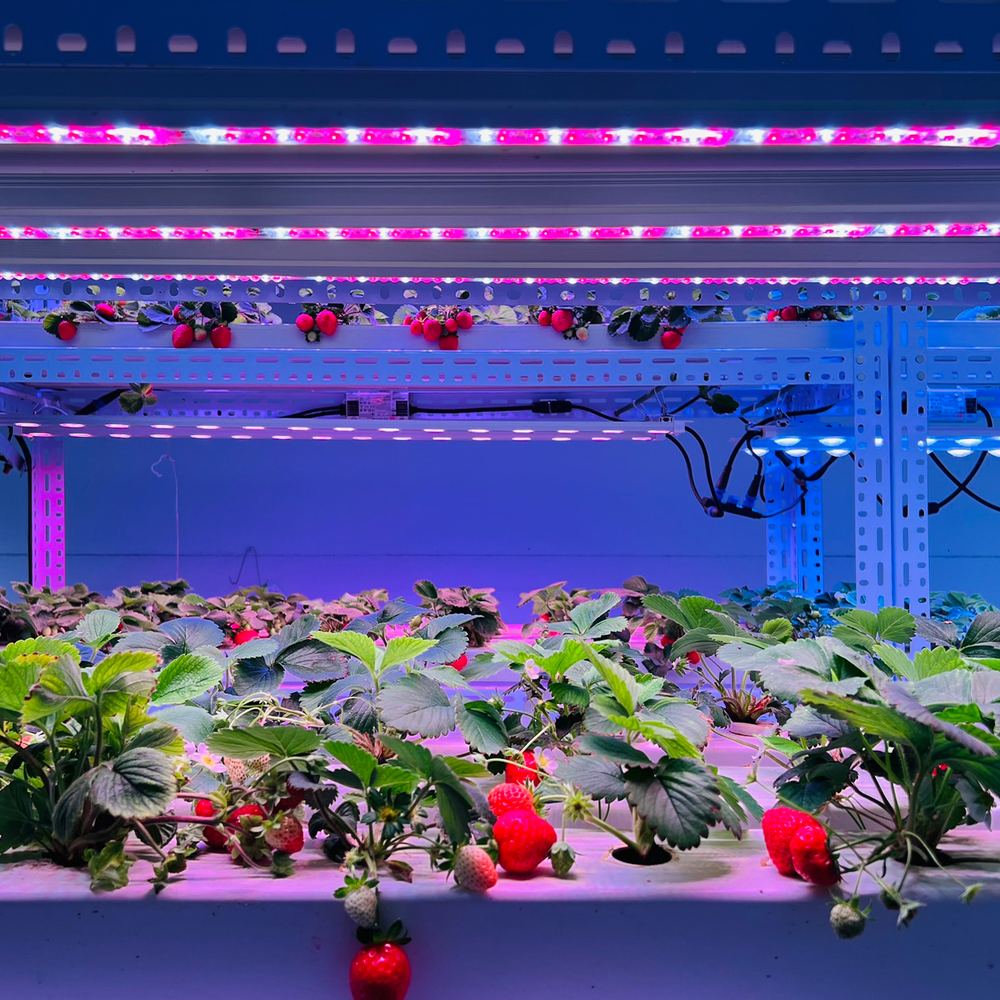
Why microgreens change the lighting calculation
In a grow room for a long-cycle crop, light design has to survive a canopy that grows toward the fixture and closes over the aisle. Growers cope with that by designing for the end of the cycle, and the early stages are simply over-lit. A microgreen rack inverts the problem. The canopy is shallow throughout, the crop is harvested before it can shade itself, and the trays are handled constantly, so the design levers that matter are the ones that stay constant: a DLI target the whole rack can hit, a photoperiod that fits the workflow, and enough clearance that a single fixture can cover a full tray evenly.
The other structural difference is repetition. A microgreen operation is usually a stack of identical tiers, so any error in the per-tier design is multiplied by the number of tiers, and any saving is multiplied in the same way. That is why it is worth settling the DLI and height figures before ordering fixtures rather than after.
Step 1: fix the daily light integral target
Light for plants is measured in two ways, and both are needed. Instantaneous intensity is photosynthetic photon flux density, PPFD, in micromol per square meter per second. The total delivered over a day is the daily light integral, DLI, in mol per square meter per day. The two are linked by the photoperiod:
The reference handout “The Basics of Plant Lighting” by Erik Runkle of Michigan State University, prepared for the OptimIA project, gives worked conversions for the combinations that matter indoors. The values below are reproduced from that table.
| PPFD (micromol/m2/s) | 8 h | 12 h | 16 h | 20 h |
|---|---|---|---|---|
| 50 | 1.4 | 2.2 | 2.9 | 3.6 |
| 75 | 2.2 | 3.2 | 4.3 | 5.4 |
| 100 | 2.9 | 4.3 | 5.8 | 7.2 |
| 150 | 4.3 | 6.5 | 8.6 | 10.8 |
| 200 | 5.8 | 8.6 | 11.5 | 14.4 |
| 300 | 8.6 | 13.0 | 17.3 | 21.6 |
| 500 | 14.4 | 21.6 | 28.8 | 36.0 |
For indoor sole-source production, the same handout lists a typical PPFD of 150 to 250 micromol per square meter per second for leafy greens and herbs, run 12 to 24 hours a day. Read against Table 1, that band corresponds to roughly 9 to 18 mol per square meter per day at 16 hours, which is also where microgreen research tends to sit. Trials summarised in Modern Concepts & Developments in Agronomy put the effective PPFD for microgreens at 100 to 200 micromol per square meter per second, and separate work on photoperiod reported further growth gains when the daily light integral was raised from about 15.6 to 23.3 mol per square meter per day by extending the light period rather than the intensity.
A workable target for a mixed microgreen rack is therefore 10 to 20 mol per square meter per day. Choose within that band by species and by the size you sell: brassicas and legumes reward the upper half, while mild, pale-stemmed varieties are usually sold for texture and go to market before extra photons change anything. Michigan State University Extension publishes DLI guideline tables for horticultural crops that are worth reading before you commit to a number, with the caveat attached to them that they describe plants of at least moderate quality grown at moderate temperatures.
Step 2: choose the photoperiod
The photoperiod is the cheapest variable to change and the one most often fixed by habit. It matters twice: it divides into the DLI to give the PPFD you have to deliver, and it sets the schedule for irrigation, airflow and harvest.
Microgreens are normally given a dark period. Published guidance for the crop describes darkness through the first days after sowing while germination completes, then 12 to 16 hours of light per day. A 16 hour period sits well inside that range and produces the DLI values in Table 1 at moderate intensities, which is why it is the usual starting point.
Extending the period is the practical way to raise DLI when fixtures are already at a comfortable height and the intensity cannot go higher without moving them closer. Running 20 hours instead of 16 lifts the DLI by a quarter at the same PPFD, as Table 1 shows. The trade-offs are electricity cost, a shorter dark period, and less time in the day for maintenance with the lights off. If you do extend it, do so on one tier and compare harvest weight, tray uniformity and electricity use before rolling it out.
Step 3: set the tier height and check uniformity
Once the PPFD target is known, the tier height becomes a measurement problem rather than a guess. Microgreens are shallow, which tempts designers to compress the rack. The limit is not the plant, it is the light distribution: a fixture close to the tray throws a bright patch directly underneath and much less at the tray edges, and a tray harvested in one pass needs the whole surface in the same condition.
The way to set it is to measure rather than to trust a chart. Put a quantum sensor, or a calibrated meter, at tray level and take readings at the centre, at the mid-points and at all four corners of the tray. Then raise the fixture in steps and repeat. There will be a height beyond which the difference between centre and corner stops improving; that is where the fixture's beam has blended and further height only wastes light and space. Purdue University Extension's publication HO-238-W, on measuring daily light integral in a greenhouse, sets out the same measurement discipline for DLI, including the caution that readings have to be taken at canopy level and with the correct instrument, because a lux meter cannot substitute for a photon measurement.
Step 4: match fixtures to the rack plan
With a DLI target, a photoperiod and a workable height, the remaining decision is which arrangement delivers the target across the whole tray. The three arrangements below are the ones used in microgreen racks, and they differ in what they do to the layout rather than in their headline efficiency.
| Arrangement | Clearance needed | Uniformity across a tray | Effect on rack design | Fits best when |
|---|---|---|---|---|
| Single wide fixture per tier | Highest; the beam needs distance to blend | Good in the middle, weaker at the ends of a wide tray | Forces taller tiers and therefore fewer of them | Trays are narrow and the rack height is not the constraint |
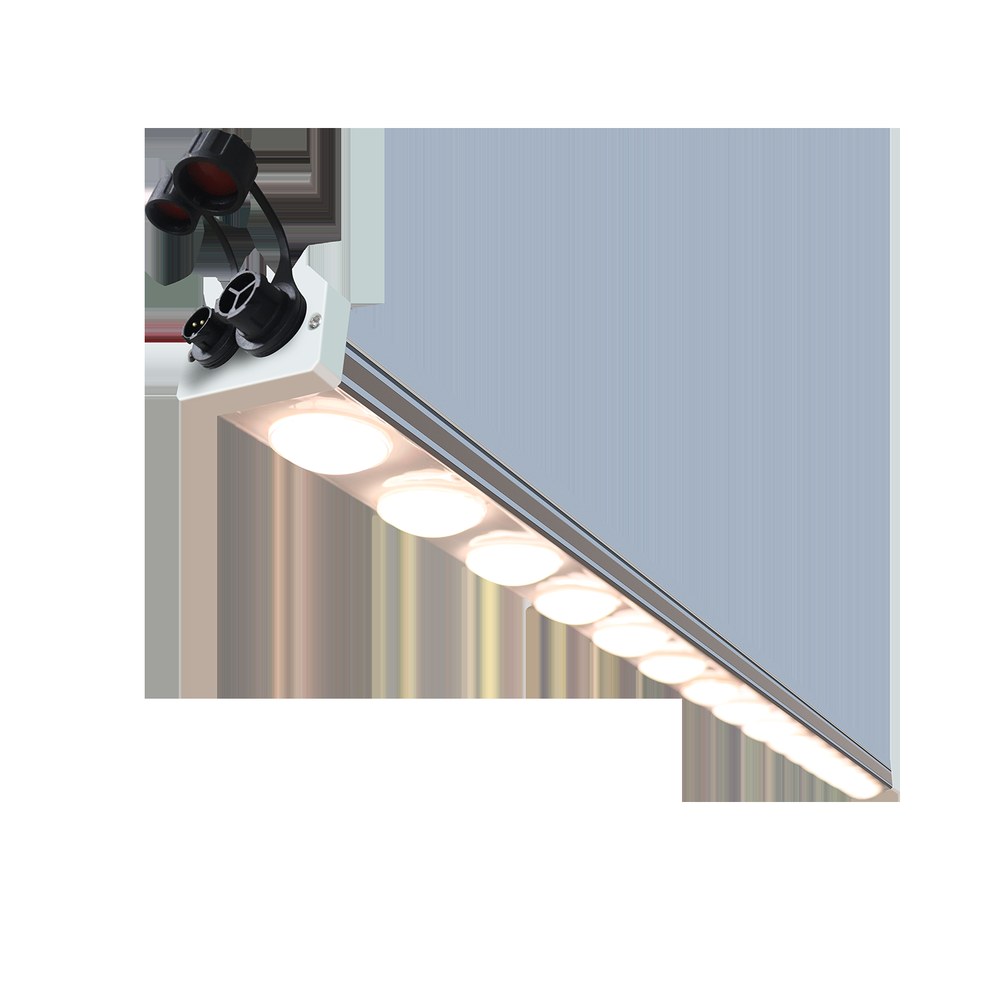
| Multiple linear bars per tier | Lower; overlapping beams blend sooner | Can be tuned by adjusting bar spacing | Tiers can be shorter, so more tiers fit in the same room | Standard tray widths and a rack that is already built |
| Bars plus reflective side panels | Similar to multiple bars | Raised at the tray edges if geometry and reflectivity are right | Adds a maintenance item; panels must not block airflow | Edge trays consistently underperform and re-spacing is not possible |
Efficiency is a separate axis and is quoted as photosynthetic photon efficacy, in micromol per joule. Two fixtures can be equally effective at delivering a DLI target while differing in the electricity they draw to do it, so the procurement question is which of the arrangements above can hit the target at the lowest input power once the layout has been fixed.
Worked example: a four-tier rack
The arithmetic below is illustrative: the areas, tariff and efficacy figures are chosen to make the method visible and are not measurements of any product.
Assume each tier holds one tray 1.2 m long and 0.6 m wide, so 0.72 m2 of growing area. The target is 14 mol per square meter per day on a 16 hour photoperiod.
Required PPFD at tray level = 14 / (16 x 0.0036) = 14 / 0.0576 = 243 micromol per square meter per second.
Required photon output per tier = 243 x 0.72 = 175 micromol per second. If the bars being considered deliver 2.8 micromol per joule, the input power needed is 175 / 2.8 = 62.5 W per tier, so about 250 W for four tiers. At 16 hours a day that is 4 kWh per day for the rack before any allowance for drivers and controls.
Two checks follow. First, is 243 micromol per square meter per second achievable at a height you can live with? If not, trade a longer photoperiod for a lower PPFD using Table 1: 20 hours needs only 243 x 16 / 20 = 194 micromol per square meter per second for the same DLI. Second, is the power per tier within the electrical plan for the room, including inrush when all tiers switch on together?
Layout mistakes that cost yield
Designing to a fixture's peak PPFD instead of its average output across the tray. The peak value is measured under the centre of the fixture; trays are harvested across their whole area.
Fixing the tier height before measuring. A height that looks generous on a drawing can still leave a hot spot in the middle of the tray, and a height that looks tight can be fine if the bars overlap.
Extending the photoperiod to rescue an under-powered design without checking the tariff. The DLI target can be met either way, but the running cost cannot.
Designing one tier and multiplying. Airflow, heat removal and access all behave differently at the top and bottom of a rack, and the tiers closest to the floor are usually the first to show it.
Frequently asked questions
What daily light integral do microgreens need?
There is no single mandatory value, because species and harvest stage differ. A practical starting range is 10 to 20 mol per square meter per day, which is what most microgreen racks deliver when they run 150 to 300 micromol per square meter per second for 12 to 20 hours. In the Michigan State University Extension reference table, 200 micromol per square meter per second over 16 hours equals 11.5 mol per square meter per day, and 300 over 16 hours equals 17.3.
How do I convert a DLI target into a PPFD setting?
Divide the DLI target by 0.0036 times the photoperiod in hours. For a 14 mol per square meter per day target on a 16 hour schedule, the required PPFD is 14 / 0.0576, about 243 micromol per square meter per second at canopy level.
How much clearance should there be between tiers?
Clearance is set by the light distribution you need, not by the plants. Microgreens are harvested young, so the canopy stays shallow, but the fixture still has to be far enough from the tray for its output to blend into an even field. Measure at tray level across the surface and raise the fixture until the difference between centre and corners stops improving.
Can microgreens be grown under 24 hour light?
Microgreens are commonly given a dark period, and 12 to 16 hours a day is a typical recommendation after the germination phase. Extending to 24 hours raises the DLI without raising instantaneous intensity, which helps when fixtures cannot be driven harder, but it removes the dark period and increases electricity use. Test the schedule on one tier before changing the rack.
Does more light always mean more microgreen yield?
No. Yield responds to DLI up to a point and then flattens, and past that point extra photons are paid for without being used. Once the crop is near the top of its response curve, uniformity across the tray usually returns more than extra intensity, because uneven light produces a mixed tray that cannot be harvested in one pass.
About the publisher
Zhongshan City Ruixian Electronics Factory (XineLam) designs and manufactures LED lighting products and LED grow light modules. The company has 17 years of experience in the LED lighting industry and holds 300+ patents in China and internationally.
This page is a technical explainer assembled from the published research and extension material listed below. Lighting layouts in working facilities also have to satisfy electrical, fire and food-safety rules that vary by location, and nothing here replaces a local assessment.
References
- Runkle, E. The Basics of Plant Lighting. OptimIA project handout, Michigan State University, July 2023. https://scri-optimia.org/pdf/2023-07 The basics of plant lighting handout, Runkle.pdf (accessed 13 October 2026).
- Runkle, E. DLI ‘requirements’. Michigan State University Extension. https://www.canr.msu.edu/resources/dli-requirements (accessed 13 October 2026).
- Purdue University Extension. Measuring Daily Light Integral in a Greenhouse (HO-238-W). https://ag.purdue.edu/department/hla/extension/extension-publications-library/ext-pubs/ho-238-w.html (accessed 13 October 2026).
- Wollaeger, H. and Runkle, E. Low daily light integrals in northern latitudes. Michigan State University Extension, 15 December 2014. https://www.canr.msu.edu/news/low_daily_light_integrals_in_northern_latitudes (accessed 13 October 2026).
- The Photoperiod/Light Intensity Ratio Affects the Yield of Microgreens. Modern Concepts & Developments in Agronomy (Crimson Publishers). https://crimsonpublishers.com/mcda/fulltext/MCDA.000760.php (accessed 13 October 2026).
Note on scope: this guide describes how to design a lighting layout from published performance data. It does not recommend a specific product, and the worked example uses illustrative area, tariff and efficacy figures. Confirm the PPF, PPFD distribution and efficacy values of any fixture against its test data before purchase.