How to Use PAR38 LED Grow Light Bulbs for Supplemental Indoor Spot Lighting
While large-scale commercial greenhouses and vertical farms rely on massive multi-bar fixtures and quantum boards, botanical displays, research benches, tissue culture acclimation shelves, and indoor specimen growers require targeted, modular spot illumination. The PAR38 format (Parabolic Aluminized Reflector, 38/8-inch diameter approx. 120 mm) fitted with standard E26/E27 screw bases provides an agile, high-intensity solution. This guide details how optical beam angles, mounting heights, and photon flux density interact to deliver precise PPFD and DLI targets for indoor spot cultivation.
- 1. Optical Characteristics and Beam Distribution of PAR38 Bulbs
- 2. Distance vs. PPFD Mapping and Inverse Square Law Dynamics
- 3. Targeted Spot Lighting for Different Plant Categories
- 4. Electrical Installation, Socket Ratings, and Thermal Safety
- 5. Frequently Asked Questions
- 6. About the Publisher
- 7. References
1. Optical Characteristics and Beam Distribution of PAR38 Bulbs
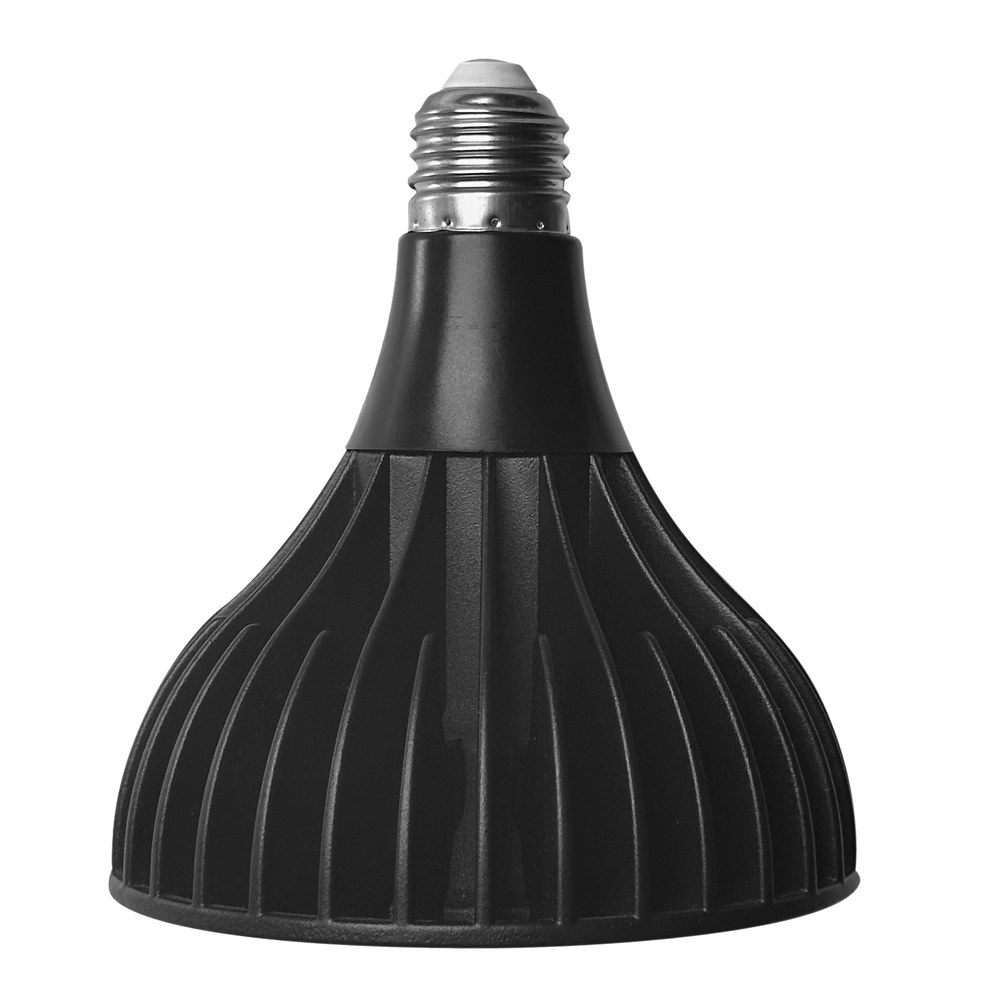
Unlike diffuse flat-panel grow lights that emit across a broad 120° Lambertian distribution, PAR38 LED grow bulbs integrate directional secondary optical lenses (typically 30°, 45°, or 60° Full Width at Half Maximum, FWHM). This tight optical beam concentration produces distinct performance advantages:
- High Central PPFD: By focusing the 25–45 µmol/s total photosynthetic photon flux (PPF) of a 15W–25W LED engine into a narrow solid angle, center-beam PPFD can reach 400–800 µmol/m²/s at 30 cm distance.
- Minimal Peripheral Photon Spill: Tight beam cutoff prevents light trespass into living or viewing spaces, directing nearly 85% of emitted photons directly onto the target canopy.
- Deep Canopy Penetration: The focused downward vector penetrates vertical foliage layers significantly better than diffuse ceiling panels.
2. Distance vs. PPFD Mapping and Inverse Square Law Dynamics
Light intensity from directional point sources attenuates rapidly as mounting height increases. Extension horticulturists at Michigan State University and the University of Illinois emphasize the importance of matching fixture distance to seedling and plant tolerances:
| Mounting Distance (cm / in) | Effective Spot Diameter (60° Lens) | Center PPFD (18W Full Spectrum) | Center PPFD (30W High Output) | DLI @ 14h Photoperiod (18W Center) |
|---|---|---|---|---|
| 15 cm (6 in) | 17 cm (~0.02 m²) | 850 µmol/m²/s | 1,420 µmol/m²/s | 42.8 mol/m²/day (Caution: Saturation) |
| 30 cm (12 in) | 35 cm (~0.10 m²) | 320 µmol/m²/s | 540 µmol/m²/s | 16.1 mol/m²/day (Ideal for Herbs/Cacti) |
| 45 cm (18 in) | 52 cm (~0.21 m²) | 150 µmol/m²/s | 260 µmol/m²/s | 7.6 mol/m²/day (Tropical Foliage) |
| 60 cm (24 in) | 69 cm (~0.37 m²) | 85 µmol/m²/s | 145 µmol/m²/s | 4.3 mol/m²/day (Low-Light Maintenance) |
As documented in Table 1, increasing the suspension height from 30 cm to 60 cm decreases central PPFD by approximately 73%, while the illuminated surface area expands by 3.7 times. Growers must balance intensity requirements against target canopy footprint.
3. Targeted Spot Lighting for Different Plant Categories
University of Illinois Extension guides for indoor seedling and plant care recommend tailoring the Daily Light Integral (DLI) to specific plant physiological groups:
- Seedlings and Micro-Greens: Target PPFD: 120–200 µmol/m²/s (DLI: 6–10 mol/m²/day). Mount an 18W PAR38 bulb at 40–45 cm to provide uniform coverage over a standard germination tray without thermal leaf curling.
- Succulents, Cacti, and Sun-Demanding Herbs: Target PPFD: 300–450 µmol/m²/s (DLI: 15–23 mol/m²/day). Position bulb at 25–30 cm directly above the specimen.
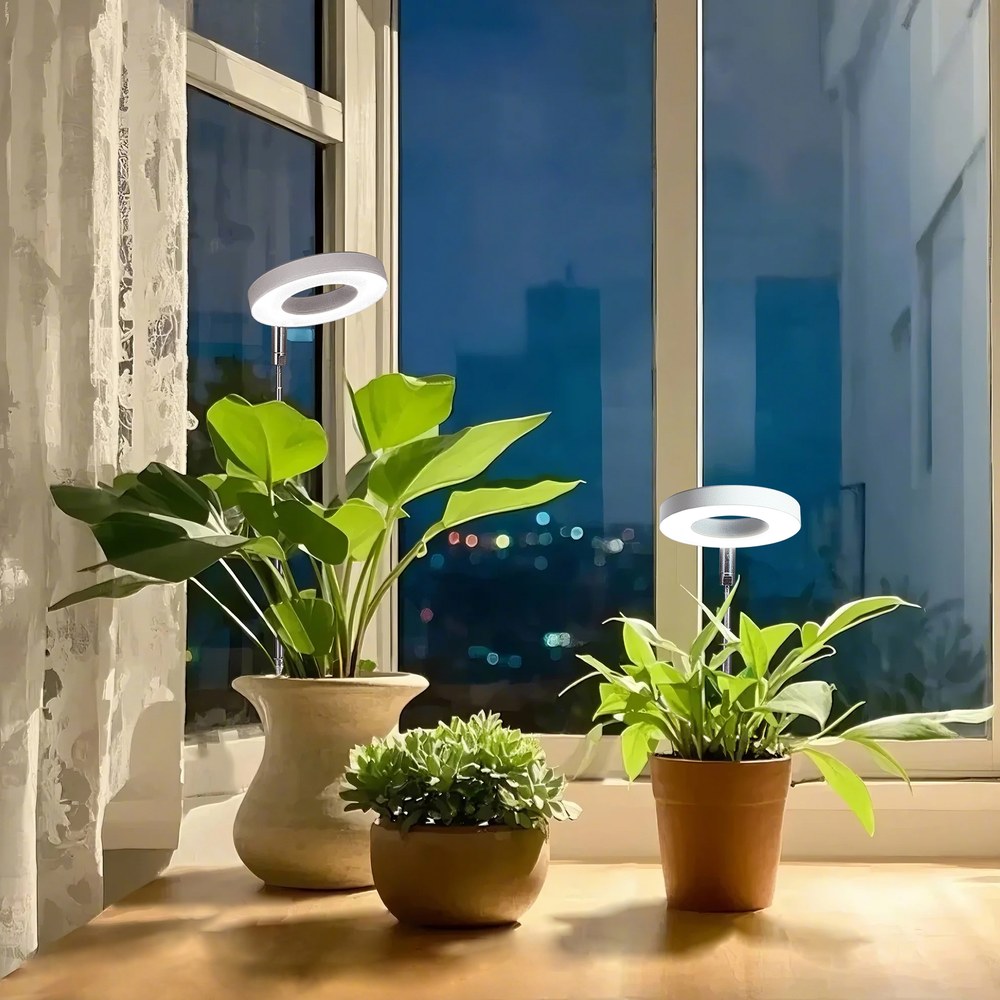
- Tropical Foliage (Monstera, Ficus, Philodendron): Target PPFD: 100–180 µmol/m²/s (DLI: 5–9 mol/m²/day). Mount at 50–60 cm for aesthetic accent and healthy vegetative growth.
4. Electrical Installation, Socket Ratings, and Thermal Safety
Because screw-in horticultural LED lamps operate under long duty cycles (12–18 hours daily), proper electrical and thermal precautions are essential:
- Socket Material: Always use glazed ceramic or porcelain E26/E27 lamp holders. Avoid enclosed plastic or synthetic lamp shades that trap convective heat.
- Passive Air Convection: Ensure at least 10 cm of unobstructed air clearance around the bulb's finned aluminum body to maintain junction temperatures below 70°C and ensure a 50,000-hour L70 lifespan.
- Water and Humidity Rating: Look for IP54 to IP65 moisture-sealed lens caps when operating near overhead misting or high-humidity propagation domes.
5. Frequently Asked Questions
What is the standard coverage area for a single 15W–36W PAR38 LED grow bulb?
With a standard 30° to 60° optical beam angle mounted at a distance of 30 to 45 cm (12 to 18 inches), a single PAR38 bulb provides intense photosynthetic spot lighting over a circular canopy diameter of 40 to 60 cm (approx. 0.15 to 0.30 m²), making it ideal for individual specimens, mother plants, or compact tiered displays.
How does mounting distance affect PAR38 PPFD according to the inverse-square law?
Because PAR38 bulbs concentrate light into directional beams, doubling the distance from the canopy reduces the center PPFD by roughly 70% to 75% while quadrupling the illuminated footprint. For example, a bulb delivering 500 µmol/m²/s at 30 cm drops to approximately 140 µmol/m²/s at 60 cm.
Can standard E26/E27 ceramic household light sockets safely power PAR38 grow lamps?
Yes. Standard PAR38 grow bulbs utilize universal E26 or E27 screw bases. However, because horticultural bulbs operate continuously for 12 to 18 hours daily with passive aluminum heatsinks, high-temperature ceramic (porcelain) sockets with adequate open airflow are strongly recommended over enclosed plastic fixtures.
How do I calculate the Daily Light Integral (DLI) delivered by a PAR38 spot lamp?
Calculate DLI using the formula: DLI (mol/m²/day) = PPFD (µmol/m²/s) × Operating Hours × 0.0036. For example, a tropical foliage plant receiving 150 µmol/m²/s under a PAR38 bulb for 14 hours per day receives a DLI of 7.56 mol/m²/day, satisfying its vegetative maintenance requirements.
Zhongshan City Ruixian Electronics Factory (XineLam) designs and manufactures LED lighting products, directional horticultural bulbs, and commercial plant grow light systems. The company has 17 years of experience in the LED lighting industry and holds 300+ patents in China and internationally.
7. References
- Lopez, R. and Runkle, E. (2022). Blooming by Lamplight: Flowering responses of plants under screw-in LED lamps. Michigan State University Extension (MSU CANR Floriculture). Available at: https://www.canr.msu.edu/resources/blooming-by-lamplight.
- Burns, C. (2018). A Primer to Supplemental Lighting for Indoor Seed Starting. University of Illinois Extension, Good Growing. Available at: https://extension.illinois.edu/blogs/good-growing/2018-03-05-primer-supplemental-lighting-indoor-seed-starting.