Does Interlighting Pay Off in Tall Crops? Under-Canopy LED Lighting for Tomatoes and Cucumbers
In a two-metre high-wire tomato or cucumber crop, the leaves at the top of the canopy and the leaves around the fruit do not see the same amount of light. Interlighting — putting part of the supplementary light inside the canopy rather than all of it above the crop — is the standard response to that gradient in Dutch glasshouses. This guide separates what has actually been measured from what is assumed, and turns the measurements into a mounting and ratio decision.
- Why a tall canopy develops a light gradient
- What interlighting changes, physically
- What the research measures
- Top lighting vs top plus interlighting, dimension by dimension
- Setting the ratio and the mounting heights
- Where interlighting does not repay the work
- Where this matters in practice
- Frequently asked questions
- About the publisher
- References
Why a tall canopy develops a light gradient
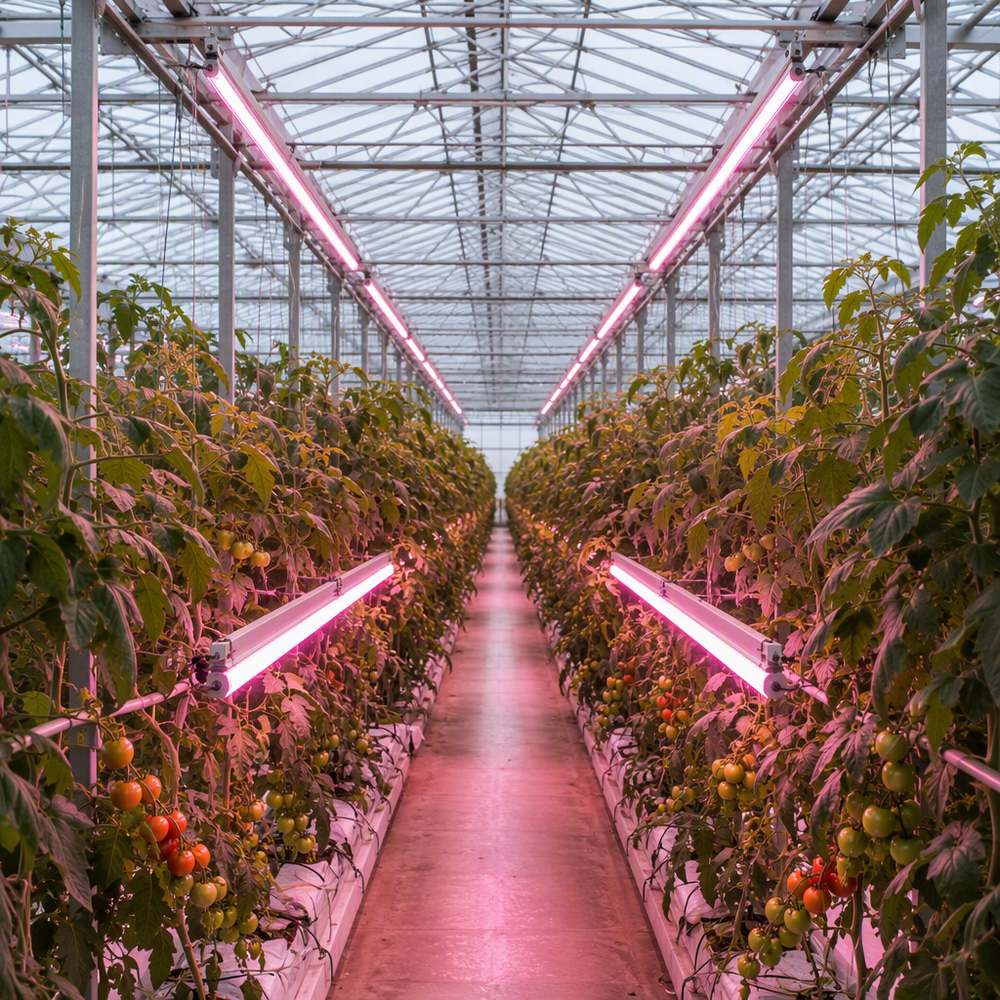
Light entering a canopy from above is intercepted by the first leaves it meets. In a crop with a high leaf area index, the leaves in the upper layer take most of the incident light, and the fraction reaching each successive layer below falls away roughly exponentially with the leaf area above it. In a bench crop of lettuce that is barely visible, because the canopy is only a few centimetres deep. In a tomato or cucumber crop trained up a string to two metres or more, it is the dominant feature of the light environment: the leaves close to the fruit trusses sit in the weakest light in the house, and they are the leaves feeding the harvest.
The gradient is a consequence of geometry, not of a badly designed installation. Adding more fixtures above the crop raises the light level everywhere, including at the top, and therefore preserves the ratio between the top and the bottom of the canopy. That is why the question in a tall crop is not only how much light to install but where to put it.
What interlighting changes, physically
An interlighting installation moves a share of the installed light into the space between the plant rows, usually with linear or tube-format fixtures mounted sideward-facing at one or more heights inside the canopy. Two physical changes follow.
- Less reflection loss at the top. Light delivered inside the canopy is not first reflected off the upper leaves and structure, so a larger fraction of the emitted photons is available to be absorbed lower down. The Wageningen modelling study behind this article cites this reduction of upper-canopy reflection loss as one of the mechanisms that motivated intra-canopy lighting.
- A different, not automatically better, distribution. Light coming from inside the canopy is uneven in a way that top light is not: measured in the horizontal direction, the coefficient of variation of absorbed light was 48% for intra-canopy lighting against 43% for top lighting in the study's tomato canopy. Light from a bar between two rows falls off rapidly with sideways distance from that bar.
Those two effects pull in opposite directions, which is the reason the published answer is usually a combination rather than a straight substitution.
What the research measures
The most directly useful published comparison is a 2023 study from Wageningen University & Research, which calibrated a functional-structural plant model of a tomato crop against measured light absorption and then simulated three lighting strategies at equal installed light: top lighting only, intra-canopy lighting only, and a 50/50 combination. The reported results were:
- Uniformity. The coefficient of variation of absorbed light in the horizontal direction was 43% for top lighting and 48% for intra-canopy lighting alone, while the combination of intra-canopy and top lighting produced the lowest value of all three at 37%.
- Total light absorption. Intra-canopy lighting on its own produced 8% higher total light absorption than top lighting, and the 50/50 combination produced 4% higher absorption.
- The ratio matters. Variation between leaves was smallest when the ratio of PPFD from intra-canopy lighting to PPFD from top lighting was about 1, and it increased as that ratio moved away from 1 in either direction.
- Height distribution matters. Spreading the intra-canopy LEDs over four heights instead of two reduced the variation further.
The same paper summarises earlier experimental work in which part of the light was moved inside the canopy: increased fruit yield in cucumber, an increase in sweet pepper fruit number and weight, and higher net photosynthesis and photosynthetic capacity in cucumber leaves. It also notes that some other trials found no difference in whole-plant biomass, and that one reason can be leaf curling when a large fraction of blue light is used from inside the canopy. A separate Wageningen trial dataset on hybrid LED and HPS lighting reports that leaves lower in the canopy under LED or hybrid interlighting treatments had a higher photosynthesis capacity in winter than leaves developed under HPS lighting.
Top lighting vs top plus interlighting, dimension by dimension
| Dimension | Top lighting only | Top lighting plus interlighting |
|---|---|---|
| Vertical light profile | Falls off steeply from the top of the canopy downward | Supplemented at one or more heights inside the canopy |
| Uniformity of absorbed light | CV 43% in the horizontal direction in the reference tomato canopy | CV 37% at a 50/50 split — the most uniform of the three simulated strategies |
| Total light absorbed, same installed light | Reference case | +4% at 50/50; +8% with intra-canopy lighting alone |
| Sensitivity to the light ratio | Not applicable | Variation is lowest at an intra-canopy to top PPFD ratio of about 1 |
| Number of mounting positions | One plane above the crop | Two or more heights; four heights lower the variation further |
| Mounting and access | Above the crop, clear of crop work | Inside the row space, sharing the volume with deleafing, harvesting and crop registration |
| Fixture requirements | Standard top-lighting formats | Compact linear or tube formats with sealed cable entries and cleanable surfaces, rigidly bracketed off the gutter or truss |
| Spectrum choice | Broad choice | Blue-rich intra-canopy spectra have been linked to leaf curling; red-rich light is the safer starting point |
| Best-fit crops | All crops | Tall, high-leaf-area crops: high-wire tomato, cucumber, sweet pepper |
| Verification | Horizontal PPFD grid at canopy height | Horizontal grid plus a vertical PPFD profile, and side-facing readings toward the fixtures |
Setting the ratio and the mounting heights
- Fix the total light budget first. Interlighting redistributes supplementary light; it does not decide how much of it the crop needs. Establish the crop's target first, then decide what share of it the installation has to deliver.
- Split the budget with the top position dominant but not overwhelming. The simulated optimum for uniformity was an intra-canopy to top PPFD ratio of about 1. A trial layout close to 2:1 — 99 µmol m−2 s−1 above the crop with 48 µmol m−2 s−1 inside it — is a realistic starting point for a first installation.
- Use more than one height. Two strings at 1.08 m and 1.53 m above the floor were the configuration in the reference experiment; four positions reduced variation further in simulation. Aim the fixtures sideward at the rows rather than downward.
- Keep the fixtures out of the crop-work envelope. Deleafing, harvesting and stem lowering happen in the same volume. Brackets fixed to the gutter or truss, with the bar held at a predictable height, are easier to work around than fixtures hung on the plant wires.
- Specify for the environment inside the canopy. The position is humid, warm and sprayed. Sealed cable entries, wipeable surfaces and a construction that tolerates being brushed against are worth more here than a small gain in efficacy.
- Measure the result. A vertical PPFD profile at several heights, plus a horizontal scan perpendicular to the rows, shows whether the lower leaves are actually receiving the share that was designed for them.
Where interlighting does not repay the work
- Short, laminar canopies. Lettuce, herbs, microgreens and young transplants do not develop the vertical gradient that interlighting is designed to correct.
- Undersized top lighting. If the installation is already short of the crop's light target, adding light above the crop is the cheaper first step. Redistribution is a second-order decision.
- No ability to measure. The whole case rests on where the light lands. Without a quantum sensor and both a vertical profile and a horizontal scan, there is no way to know whether the ratio installed matches the ratio intended.
- Installations where the crop work cannot accommodate fixtures. In tightly spaced rows with frequent manual work, brackets inside the canopy can cost more in labour than they return in uniformity.
Where this matters in practice
Interlighting is a mainstream technique in high-wire glasshouse production and an upgrade path for existing installations that are already at their top-lighting limit. In our experience supplying LED grow light modules for glasshouse and indoor projects, the installations that get value from it are the ones that treat the ratio as a design parameter: they decide the split, they use more than one mounting height, they fit the bars off the gutter rather than on the plant wires, and they verify the vertical profile after commissioning.
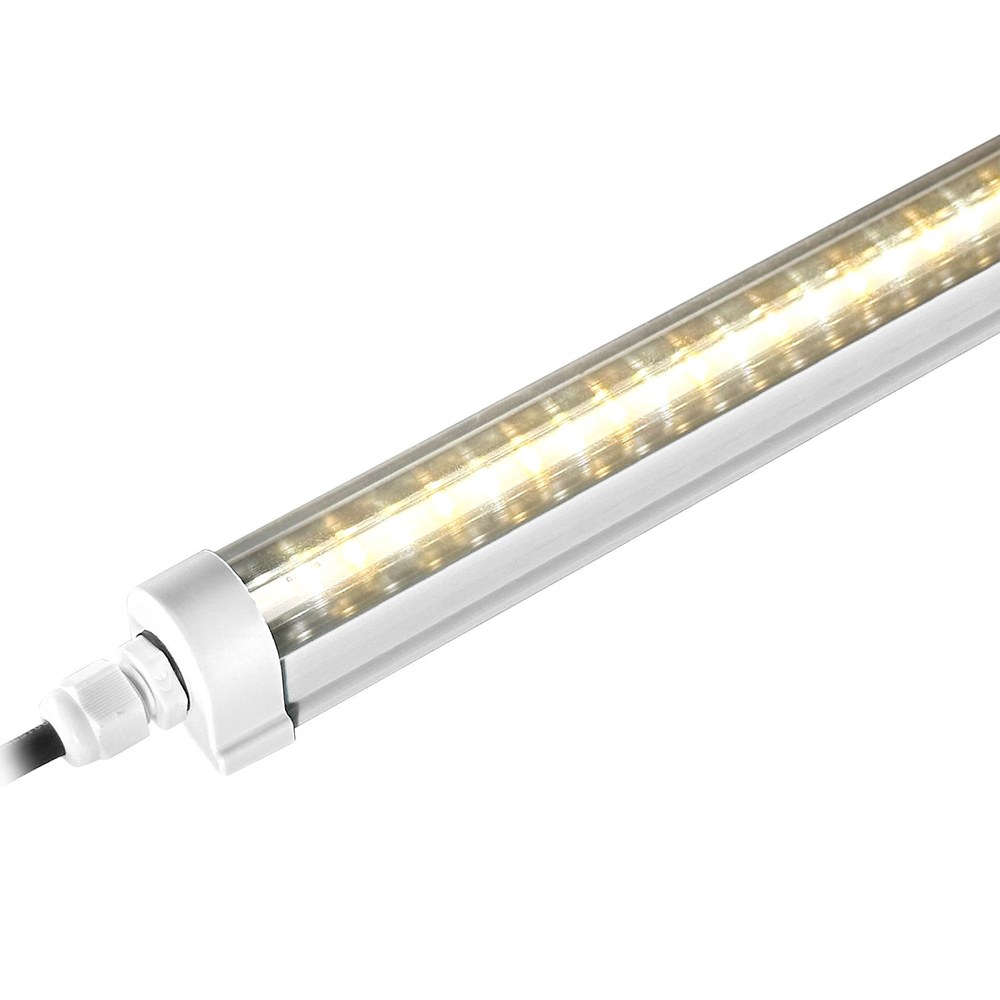
Linear and tube-format fixtures are the usual hardware for this position, because they can be mounted at a fixed height between rows and aimed sideward — sealed tube fixtures such as the PT8 T8-format LED tube, or sealed bar modules with the same mounting logic. The choice of fixture matters less than the split, the heights and the fixing points.
Frequently asked questions
What does interlighting mean?
Interlighting, also called intra-canopy or inter-canopy lighting, means placing part of the supplementary light inside the crop canopy instead of placing all of it above the crop. The lamps are mounted between the plant rows, typically at one or more heights inside the canopy, and are usually aimed sideward at the leaves.
Does interlighting actually increase yield?
The effects reported in the literature are not uniform. Earlier trials summarised in the 2023 Wageningen modelling study reported higher fruit yield in cucumber, more and heavier fruit in sweet pepper, and higher leaf photosynthesis in cucumber when part of the light was given inside the canopy, while some other trials found no difference in whole-plant biomass. What the modelling study measured directly and consistently was light distribution: intra-canopy lighting on its own absorbed 8% more light than top lighting, and a 50/50 combination absorbed 4% more.
What top-to-inter light ratio should I use?
In the simulated tomato canopy, the variation in light absorption between leaves was smallest when the ratio of intra-canopy PPFD to top-lighting PPFD was about 1, and it increased as the ratio moved away from 1 in either direction. A split in that region is the most defensible starting point; a trial layout with 99 µmol m−2 s−1 above the crop and 48 µmol m−2 s−1 inside it is an example of a roughly 2:1 top-to-inter split.
How many heights should the interlighting lamps be mounted at?
More than one. In the modelling study, distributing the intra-canopy LEDs over four heights instead of two further reduced the variation in light absorption. Deploying the fixtures at a single height concentrates light on one band of leaves and leaves the rest of the vertical profile short.
Does interlighting replace top lighting?
It is normally a partial substitution rather than a replacement. The research compares top lighting, intra-canopy lighting and a combination, and the combination gave the most uniform light absorption of the three. Removing top lighting entirely also removes the light that reaches the upper leaves and the growing point.
About the publisher
Zhongshan City Ruixian Electronics Factory (XineLam) designs and manufactures LED lighting and LED grow light modules. The company has 17 years of experience in LED lighting and holds 300+ patents in China and internationally. This article is published as technical background for growers and system integrators; it summarises published research on light distribution in tall crops and does not replace a light measurement survey of a specific installation.
Where this matters in practice: existing high-wire glasshouse installations that have reached their ceiling on top lighting, greenhouse projects specifying supplementary light for the first time, and retrofits where the lower canopy is the limiting factor rather than the house as a whole.
References
- Schipper, R., van der Meer, M., de Visser, P.H.B., Heuvelink, E., Marcelis, L.F.M. (2023). Consequences of intra-canopy and top LED lighting for uniformity of light distribution in a tomato crop. Frontiers in Plant Science 14: 1012529. Source of the coefficient-of-variation figures (43%, 48%, 37%), the +8% and +4% light absorption results, the optimum intra-canopy to top ratio of about 1, and the four-height finding. https://www.frontiersin.org/journals/plant-science/articles/10.3389/fpls.2023.1012529/full
- HortScience (American Society for Horticultural Science), 59(3): 421. Partially Substituting Top-light with Intracanopy Lighting. Peer-reviewed study on partial substitution of top lighting with intra-canopy lighting. http://journals.ashs.org/view/journals/hortsci/59/3/article-p421.xml
- Wageningen University & Research, research publication record. Growth of tomatoes under Hybrid LED and HPS lighting. Reports the comparison of HPS top lighting, LED top lighting, and hybrid treatments including LED interlighting, and the higher winter photosynthesis capacity of lower-canopy leaves under LED treatments. https://research.wur.nl/en/publications/growth-of-tomatoes-under-hybrid-led-and-hps-lighting/