LED Binning Explained: Why Bin Codes Matter for Grow Light Performance
Two grow lights can carry the same model number, the same nominal CCT and the same wattage, and still deliver slightly different light. The reason is usually binning — the sorting step that happens between LED production and fixture assembly. This guide explains what binning sorts, how the bins are defined, and which questions actually separate a consistent fixture from a variable one.
What binning is and what it sorts
An LED production line does not produce identical parts. Phosphor coating thickness, die placement, and the binning of the semiconductor material all vary slightly, so each finished LED is measured and then sorted into groups. ERCO’s technical reference on LED binning describes the process in exactly these terms: during binning, LEDs are sorted according to exact colour location, luminous flux and forward voltage, among other criteria.
That definition is worth holding on to, because it explains why a bin code is not a single score. Three independent properties are being sorted at once, and a fixture specification that quotes only one of them is describing only part of the part.
| Bin type | What is being sorted | What it controls in a grow light |
|---|---|---|
| Chromaticity (colour) bin | The exact colour location of the emitted light within a defined chromaticity region. | Whether two bars in the same room produce the same spectrum, and whether a replacement board matches the boards already installed. |
| Flux bin | Luminous flux, or light output, measured under defined test conditions. | How much output a board delivers for a given drive current, and therefore how uniform PPFD is across a canopy when several boards share a room. |
| Forward voltage bin | The forward voltage of the LED at the test current. | How a series string behaves electrically and how much headroom the driver needs, which affects driver selection and string design. |
Chromaticity bins: why the same CCT is not the same light
White light is described by a correlated colour temperature, and a CCT designation such as 3000 K or 4000 K is a shorthand for a small region on a chromaticity diagram rather than a precise point. The DesignLights Consortium glossary entry on the ANSI nominal chromaticity range states that ANSI C78.377-2015 defines chromaticity ranges associated with CCT designations for nominally white light sources using the CIE 1976 (u′, v′) chromaticity diagram, and adds the point that matters most here: each bin represents a range of chromaticity, so sources with the same nominal designation may not match.
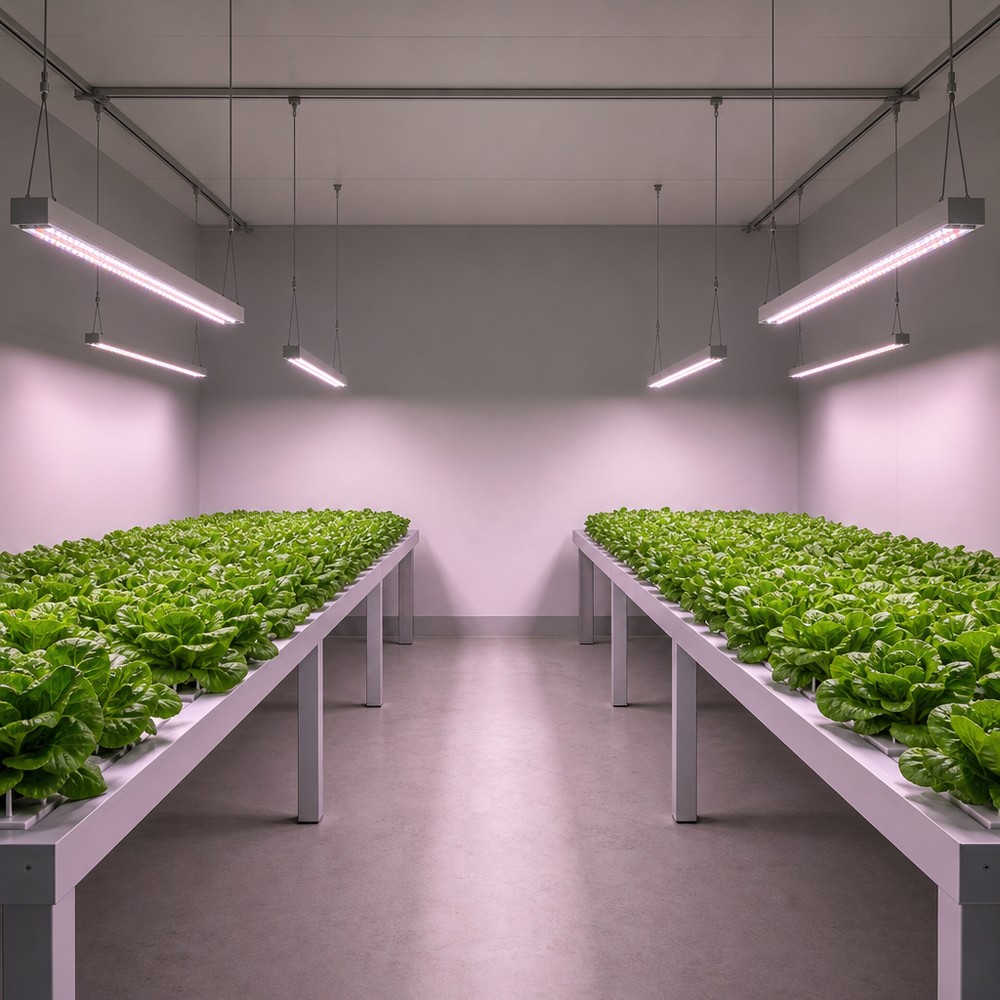
In practice, chromaticity bins are frequently described in terms of colour steps, where a smaller number of steps means a tighter region around the target. A tighter region costs more, because fewer parts from the production distribution qualify for it. For a grow room the consequence is concrete: bars built from a wide colour range can show visible differences from one end of a bench to the other, and a board added a year later may not match the light already in the room even though it carries the same model number and the same CCT label.
Flux bins and voltage bins
Flux binning works the same way on the brightness axis. LEDs are grouped into output ranges, and the width of those ranges is a manufacturing choice. A fixture that accepts a wide flux range can be built from cheaper parts, but boards built from different flux groups will not deliver identical output at the same current. In a multi-bar installation the practical result is uneven PPFD unless the boards were selected from a narrow range or the installation is measured and trimmed after hanging.
Forward voltage binning is the category most often left out of grow light marketing material, yet it is the one that constrains the electrical design. Because LEDs in a fixture are usually wired in series strings, the total forward voltage of the string depends on the voltage rank of the parts used. A supplier working with a narrow voltage range can specify a driver with less headroom; a supplier accepting a wide range has to design for the worst case. When a driver is chosen mainly on cost, the voltage spread of the LED population is one of the reasons a design ends up with less margin than expected.
Why binning matters in horticultural fixtures
Binning matters in general lighting because people notice colour differences between adjacent fixtures. In horticultural lighting there are two further reasons.
- Recipes are supposed to be repeatable. When a spectrum or a PPFD target is written into a crop plan, a board that does not match the rest of the room quietly changes the recipe for the plants underneath it. That is difficult to diagnose, because the fixture still switches on and still looks normal.
- Boards are replaced, not whole rooms. Grow lights are often bought in one batch and replaced one or two at a time later. Without recorded bin information, matching a replacement to an existing installation depends on the supplier still building boards the same way.
- Horticultural products also carry their own reporting requirements. The DesignLights Consortium’s horticultural technical requirements include an LM-80 applicability section and a photosynthetic photon efficacy threshold for listed products, which is a reminder that the documentation supplied with a fixture is part of its specification.
How to check a supplier’s binning practice
None of this requires a laboratory. It requires a specification that answers specific questions.
- Ask for the three bins, not one. A complete answer names the colour bin, the flux bin and the forward voltage bin for the emitters used on that board.
- Ask whether one board uses one bin or several. Mixed bins inside a single board produce internal variation that no amount of post-hanging adjustment can remove.
- Ask how the bins are recorded. A manufacturer that keeps bin records per production lot can match a replacement board later; one that does not cannot promise a match.
- Ask for the LED datasheet and the LM-80 report. These document the component and its measured behaviour, and they are separate documents from the fixture datasheet.
- Ask about the driver in the same conversation. The voltage bin determines how much margin the driver needs, so the two questions belong together.
- Measure a sample after installation. A quantum sensor reading across a bench confirms whether the installed boards are actually delivering a uniform distribution.
What binning does not tell you
Binning describes where a finished LED sits in a distribution. It says nothing about how that LED will age, which is a lumen maintenance question rather than a binning question. It does not describe the thermal design of the board it is soldered onto, which determines the junction temperature it will actually run at. It does not describe the driver, the optics or the ingress protection of the fixture. And a narrow bin does not by itself guarantee that a fixture is well built; it guarantees only that the emitters are closely matched to each other.
Used properly, binning information is a consistency tool. It tells a buyer whether a room full of boards will deliver the same light as the board that was measured and approved, which is what makes a crop recipe repeatable across production cycles.
Frequently asked questions
What does an LED bin code actually tell you?
A bin code records which group a finished LED fell into after production testing. LEDs are sorted by exact colour location, luminous flux and forward voltage, so a full bin code describes a colour point, a brightness rank and an electrical rank rather than a single quality score.
Can two lamps with the same CCT look different?
Yes. ANSI C78.377 defines chromaticity ranges associated with nominal CCT designations on the CIE 1976 (u′, v′) diagram, and each bin represents a range rather than a point. Because the designation covers a region, two sources with the same nominal CCT may still not match each other.
Does tighter binning make plants grow better?
Tighter binning makes a fixture more consistent, not automatically more productive. The amount of light delivered to the canopy is set by PPF, mounting height, spacing and photoperiod, so binning affects how evenly and how reproducibly that light is delivered across a room rather than how much of it there is.
Why do two boards of the same fixture model differ in output?
A board is usually built from LEDs that came from a particular production lot and bin. If a manufacturer accepts a wider flux range on some runs, or mixes bins within one board, output and colour can differ slightly between units that carry the same model number.
Is a bin a quality grade?
Not by itself. Binning is a sorting process, so a bin is a description of where a part sits inside the manufacturer’s distribution. A narrow bin is more expensive to supply because fewer parts qualify for it, but the bin label is not a statement that the LED is better designed or longer lived.
About the publisher
Zhongshan City Ruixian Electronics Factory (XineLam) designs and manufactures LED lighting and LED grow light modules. The company has 17 years of experience in LED lighting and holds 300+ patents in China and internationally. This article is published as technical background for growers and system integrators; it describes industry binning and chromaticity definitions and does not replace the component documentation supplied with a specific product.
Where this matters in practice: in multi-tier rack systems, where boards are stacked close together and any variation between bars is visible on the canopy, and in facilities that expand a room in stages, where a later batch of fixtures has to match the light already in service.
References
- ERCO. LED binning — fundamentals of LED binning, including the sorting criteria (colour location, luminous flux, forward voltage). https://www.erco.com/en_us/knowledge/fundamentals/led-binning/
- DesignLights Consortium. ANSI Nominal Chromaticity Range (glossary) — ANSI C78.377-2015 chromaticity ranges for nominal CCT designations on the CIE 1976 (u′, v′) diagram. https://designlights.org/glossaries/ansi-nominal-chromaticity-range/
- DigiKey. Decoding LED Bin Labels — how flux, chromaticity and voltage bin labels are read when selecting an LED. https://www.digikey.com/en/articles/decoding-led-bin-labels